
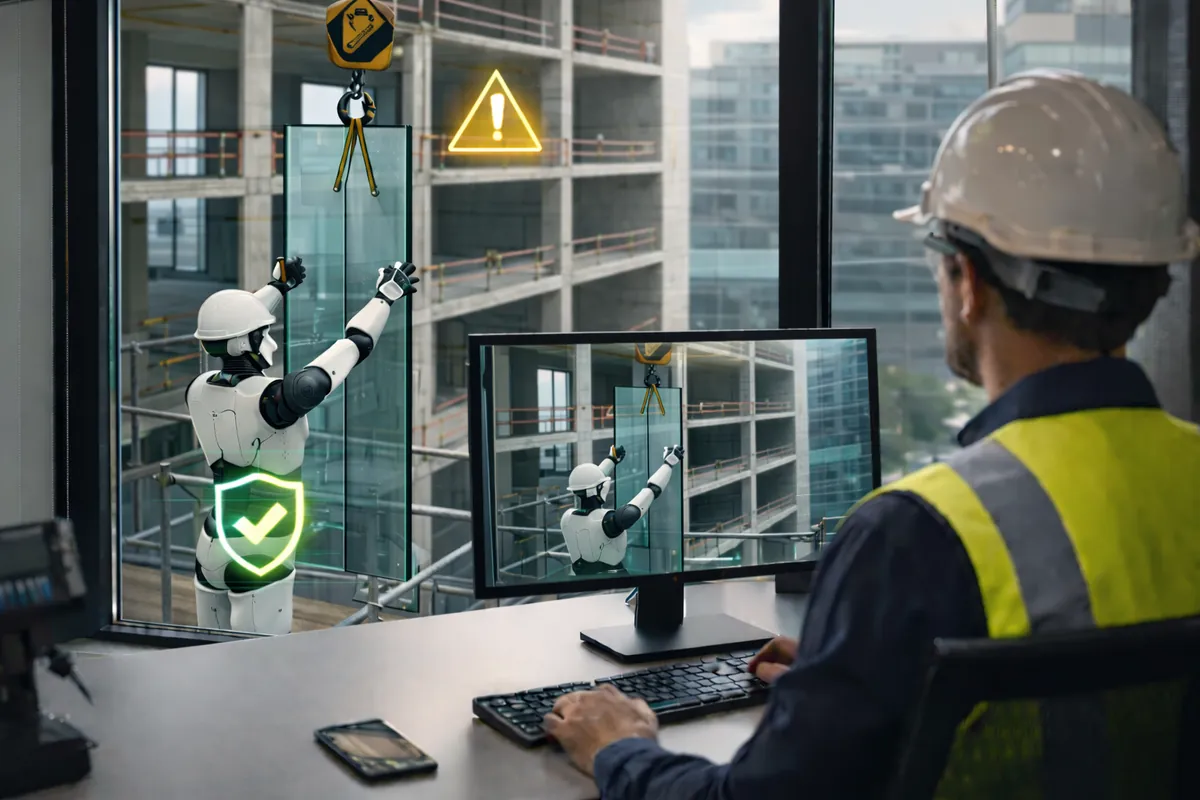
The gradual incorporation of robots and artificial intelligence systems into the workplace is profoundly transforming the organisation of work and the management of safety. Increasingly, these technologies will take on most of the dangerous jobs traditionally carried out by humans, such as work at height, handling of hazardous substances, work in confined spaces, extreme environments or repetitive activities with a high risk of accident. This progress represents a clear opportunity to reduce workplace accidents, but it also poses significant challenges for occupational risk prevention.
For decades, prevention has focused on identifying, assessing and controlling the risks arising from the direct involvement of people in production processes. However, in a highly automated scenario, risks do not disappear but rather evolve. The introduction of robots and intelligent systems generates new hazards associated with technical failures, programming errors, autonomous decisions that are hard to foresee, or unsafe interactions between people and machines. Prevention will have to adapt to this new reality in order to remain effective.
One of the main challenges will be the coexistence between workers and automated systems. Even though robots take on the most dangerous tasks, people will remain responsible for their supervision, maintenance, programming and control. This will require new risk-assessment criteria, specific safety protocols and greater coordination between technical, organisational and preventive areas. Safety will increasingly depend on the correct integration of technology, processes and the human factor.
Likewise, risk assessment will become more dynamic and complex. Artificial intelligence systems can learn and change their behaviour over time, which makes it difficult to anticipate every possible situation. Traditional preventive models, based on relatively stable scenarios, will have to evolve towards more flexible and continuous approaches, capable of adapting to changing and highly technified environments.
Added to this context is the impact on psychosocial health. Automating dangerous jobs can reduce serious accidents, but it can also generate uncertainty, technological dependence, loss of control or cognitive overload in workers who interact with advanced systems. Occupational risk prevention will have to broaden its scope to protect not only physical integrity but also the mental and emotional well-being of people.
In this new scenario, the digitalisation of preventive management will be a key factor. The ability to gather information, analyse data and update assessments continuously will be essential. In this respect, solutions such as INTEGRA PRL will have to adapt to respond to the emerging risks arising from automation, enabling more dynamic, integrated preventive management aligned with the new work environments. In this way, prevention will continue to fulfil its fundamental objective: to safeguard the safety and health of people in an increasingly technological future.